

Key Takeaways
- Coworking's roots go back to the open-plan offices and shared workspaces that emerged in the 20th century.
- Brad Neuberg's 'San Francisco Coworking Space', which opened in 2005, is widely seen as the first modern coworking space.
- The 2010s marked the transition of Coworking from independent communities to a commercial industry with significant investments.
- The COVID-19 pandemic prompted many companies to reconsider their office space needs, increasing demand for flexible coworking options.
- The Coworking market is expected to be worth over $53 billion (over £40 billion) by 2030.
Coworking is a shared office or workspace used by individuals from different organisations. Its roots stem from open-plan offices in the early 1900s and the shared workspaces that emerged in the 1980s and 1990s. However, modern coworking, which combines shared space with a strong sense of community, began in August 2005, when Brad Neuberg opened the 'San Francisco Coworking Space'.
Our timeline covers the events and milestones that shaped coworking, from its early origins to the global industry in 2026.
The Roots of Coworking: 1903 to 1999
Office design, new technology and early shared spaces paved the way before the term 'coworking' existed.
1903: Frank Lloyd Wright designed the Larkin Administration Building in Buffalo, New York. As one of the earliest known open-plan offices, it brought workers together around a central atrium. However, unlike a coworking space, it housed staff from just one company.
1980s: Advances in technology made working outside a fixed office more practical. Over the next decade, serviced offices and hackerspaces laid the foundations for modern coworking.
1985: The first telecottage opened in Vemdalen, Sweden. Telecottages were community-run centres where local people and small businesses shared computers and phone lines, an early example of individuals sharing a workspace.
1989: British entrepreneur Mark Dixon founded Regus in Brussels, offering furnished office space without the commitment of a long lease. Regus focused on serviced offices rather than coworking, but its flexible model became a cornerstone of the broader shared workspace industry.
That same year, Tim Berners-Lee proposed the World Wide Web, which launched publicly in 1991 and later allowed people to access their work from almost anywhere.
 Tim Berners-Lee at CERN, with the WorldWideWeb, the first web browser.
1994: Advertising agency Chiat/Day opened an unconventional New York office designed by architect Gaetano Pesce. Staff moved between work areas instead of using fixed desks, which encouraged collaboration. Many workers found it difficult to focus without their own space, an issue that later coworking spaces fixed by adding quiet zones.
1995: Computer enthusiasts set up C-Base as a hackerspace where members shared equipment, swapped ideas and worked on projects together. Its community-led approach, rather than a commercial one, would later shape coworking.
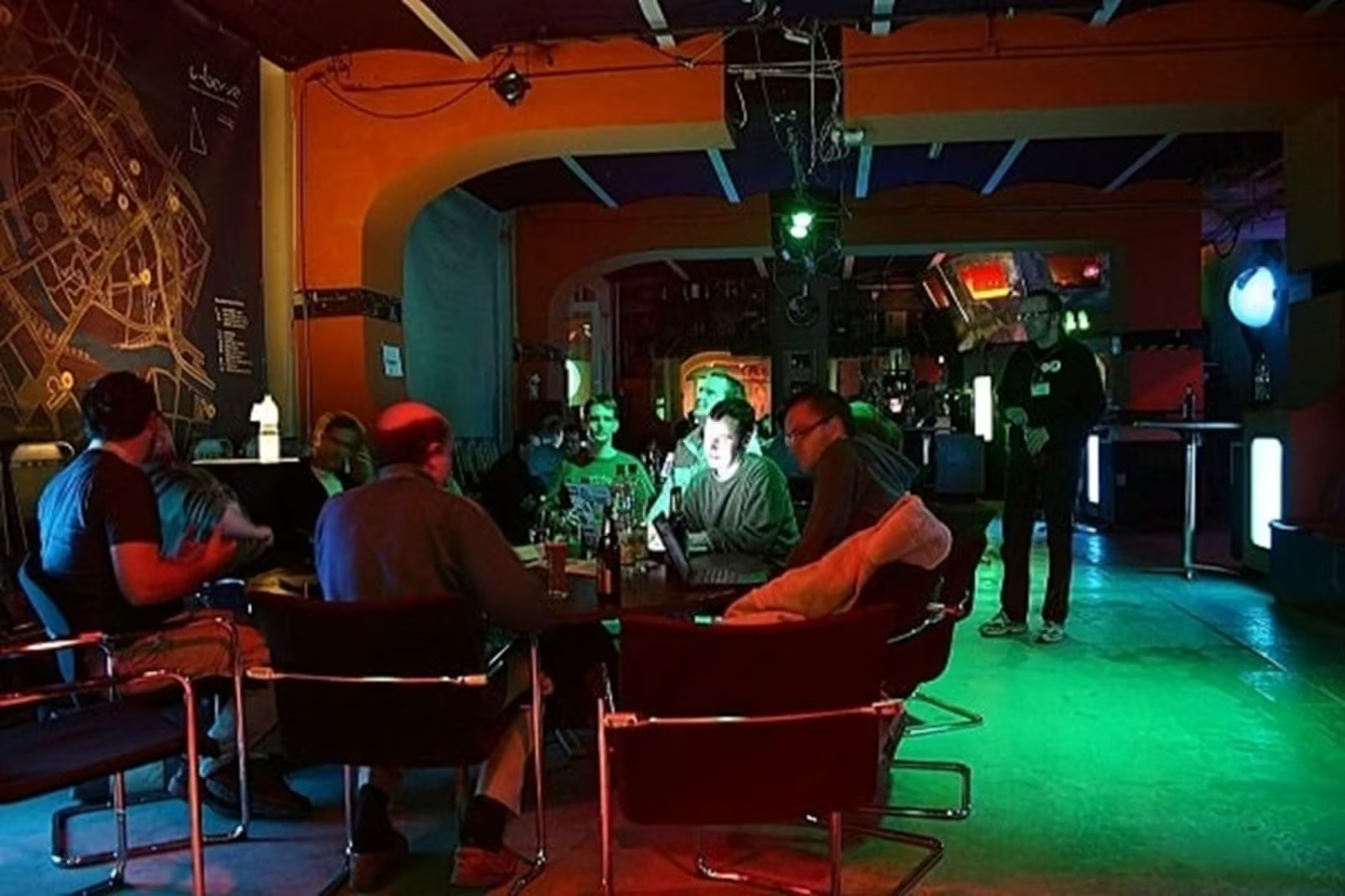
Members working together at C-Base, a hackerspace in Berlin.
1999: Game designer Bernard DeKoven used 'coworking' to describe people collaborating as equals rather than within a workplace hierarchy. Although his meaning differed from today's and modern coworking developed separately, the idea of people working together is still central to the movement.
Modern Coworking Begins: 2000 to 2009
Faster internet, portable computers and a growing freelance workforce made independent working easier in the 2000s. Shared workspaces offered regular contact with other professionals, something home working often lacked.
2002: Two Austrian entrepreneurs opened Schraubenfabrik, a centre where freelancers, architects and small businesses worked side by side. It wasn't called coworking at the time, though Deskmag later described it as Vienna's first coworking space.
In the same year, we started FreeOfficeFinder to help businesses find flexible office space in London and the UK. Although there was no real understanding of the Coworking concept back then, only private serviced offices.
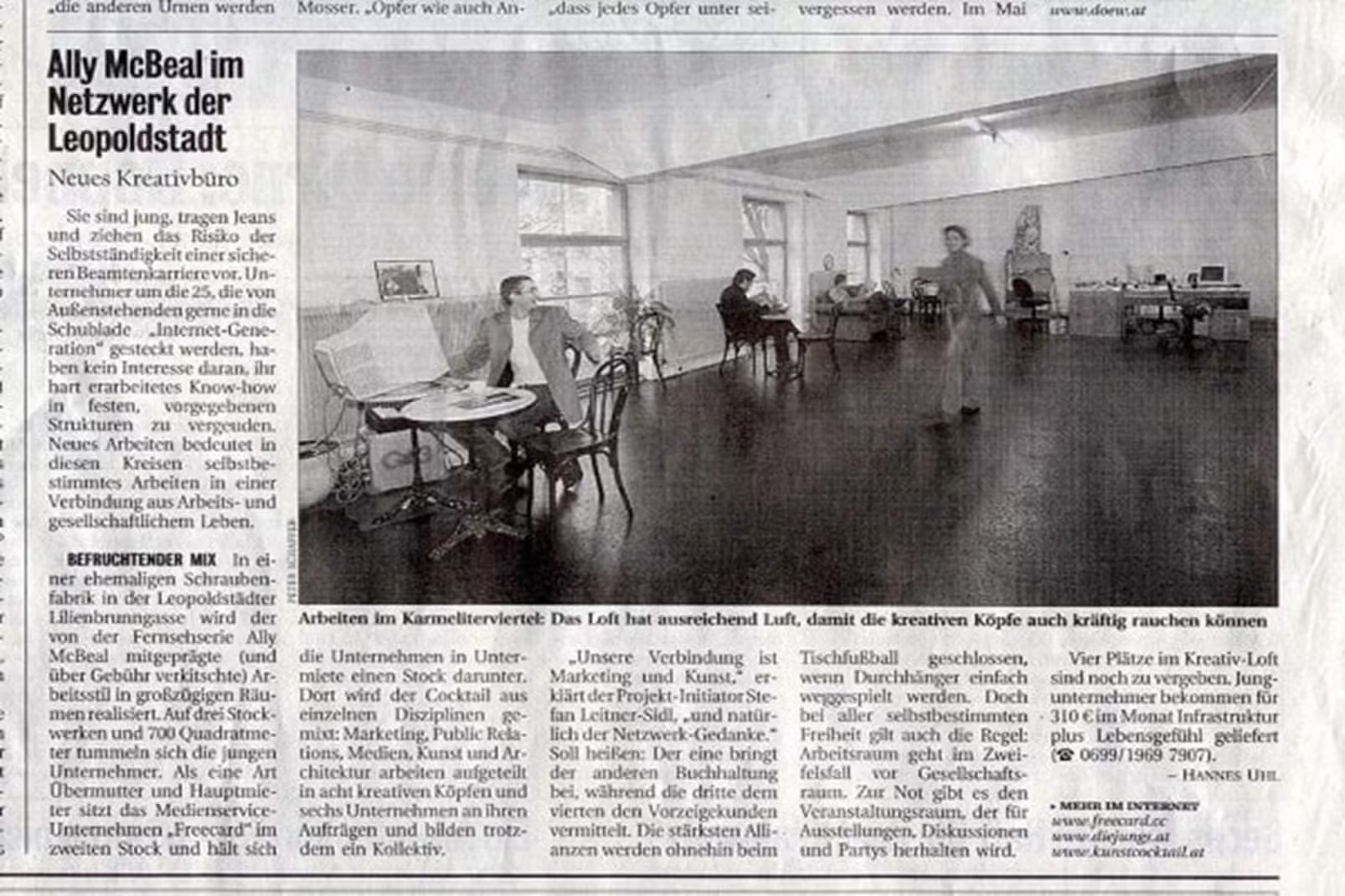
Local press coverage of Schraubenfabrik in Vienna, shortly after it opened in 2002.
2003: Software engineer Brad Neuberg set up the Nine to Five Group in San Francisco as an early attempt to bring independent workers together. He advertised on Craigslist but failed to gain traction, though the experience influenced his later approach.
2004: Schraubenfabrik’s founders opened a second site in Vienna, called Hutfabrik, creating one of the first networks of shared workspaces.
In Emeryville, California, Neil Goldberg opened Gate 3 WorkClub, a 14,000 square foot space with private areas, collaborative zones and a café. It closed after a year, highlighting that good facilities alone weren’t enough without a community to fill them.
2005: In August, Neuberg launched the 'San Francisco Coworking Space' at Spiral Muse, a community building in the Mission District. He aimed to combine the independence of freelancing with the structure and social side of office life.
Despite no one attending in the first month, software developer Ray Baxter became one of the first regular members. This model continues to define coworking, with people working independently in a shared space.
In Berlin, St. Oberholz opened as a café with free internet, which quickly drew in freelancers. The Hub in London also opened that year, inspired by community projects in Johannesburg, and later joined the Impact Hub network.
2006: After only a year, the 'San Francisco Coworking Space' closed, and Neuberg moved on to a new project, the Hat Factory, the city’s first full-time coworking space.
Early coworking advocate Chris Messina also helped set up the Coworking Wiki, an online resource where coworkers and operators could find locations and share ideas. By the end of the year, around 30 coworking spaces were operating worldwide.
2007: Coworking spaces began opening across Europe and North America. In Philadelphia, independent workers prepaid their memberships to launch Indy Hall, one of the first US coworking spaces outside of San Francisco. Coworking also gained its own Wikipedia page as the term entered wider use.
2008: Operators experimented with new types of membership. Cubes & Crayons (Silicon Valley) paired coworking with childcare, and 'Coworking visas' let members use partner spaces while travelling. More than 160 coworking spaces were now open worldwide, and the total would nearly double each year until 2012.
2009: Drew Jones, Todd Sundsted and Tony Bacigalupo published “I’m Outta Here! How Coworking Is Making the Office Obsolete”, one of the first books about the movement.
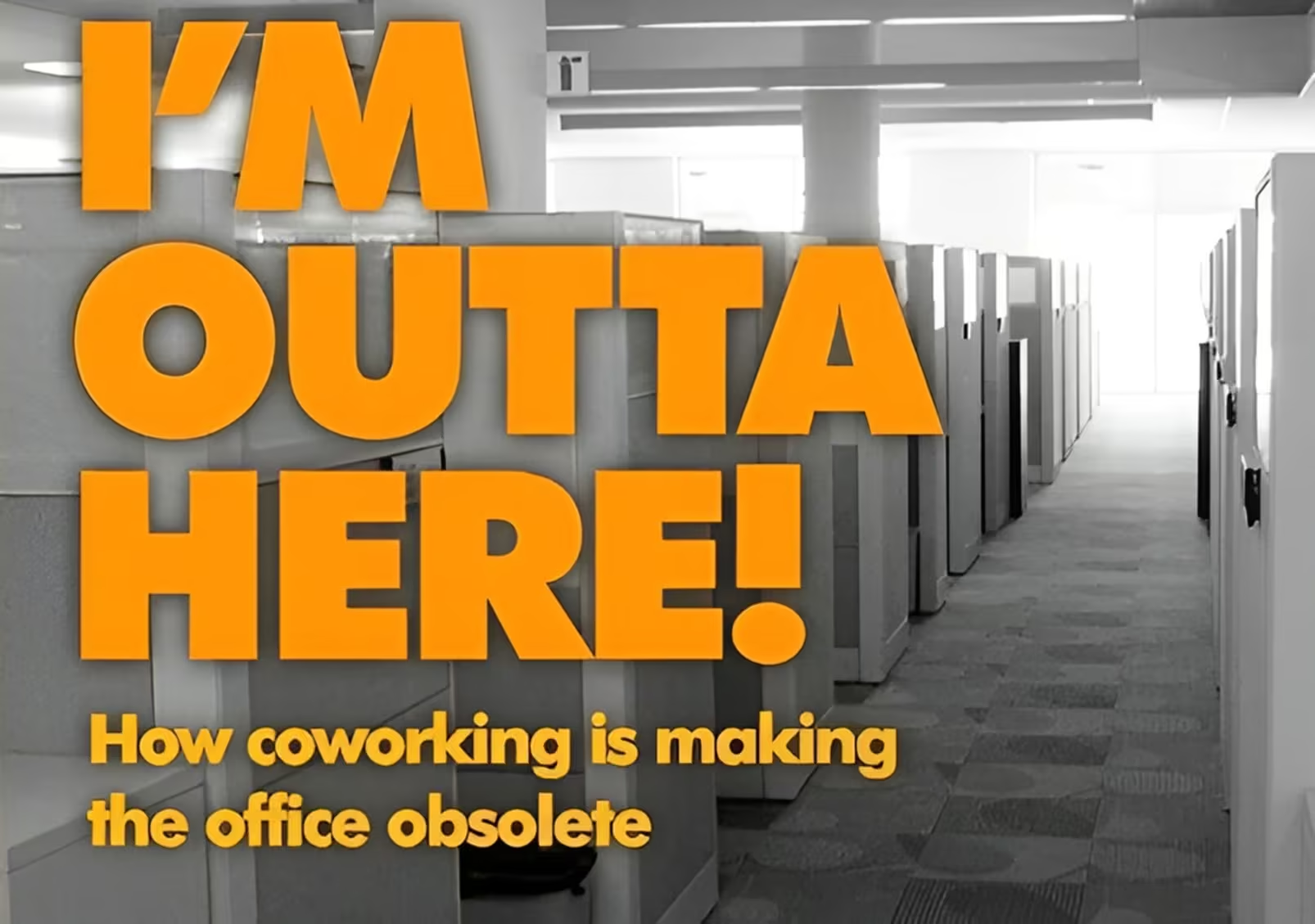
One of the first books about coworking, written by Drew Jones, Todd Sundsted, and Tony Bacigalupo, published in 2009.
Coworking Goes Global: 2010 to 2018
In the 2010s, coworking expanded from a network of independent communities into a commercial industry, attracting investors and larger businesses.
2010: Adam Neumann and Miguel McKelvey founded WeWork in New York. Unlike most early communities, it grew rapidly, pairing flexible offices with communal areas, events and a distinctive brand.
That same year, Deskmag launched as an online publication covering coworking, and its surveys counted about 600 spaces worldwide.
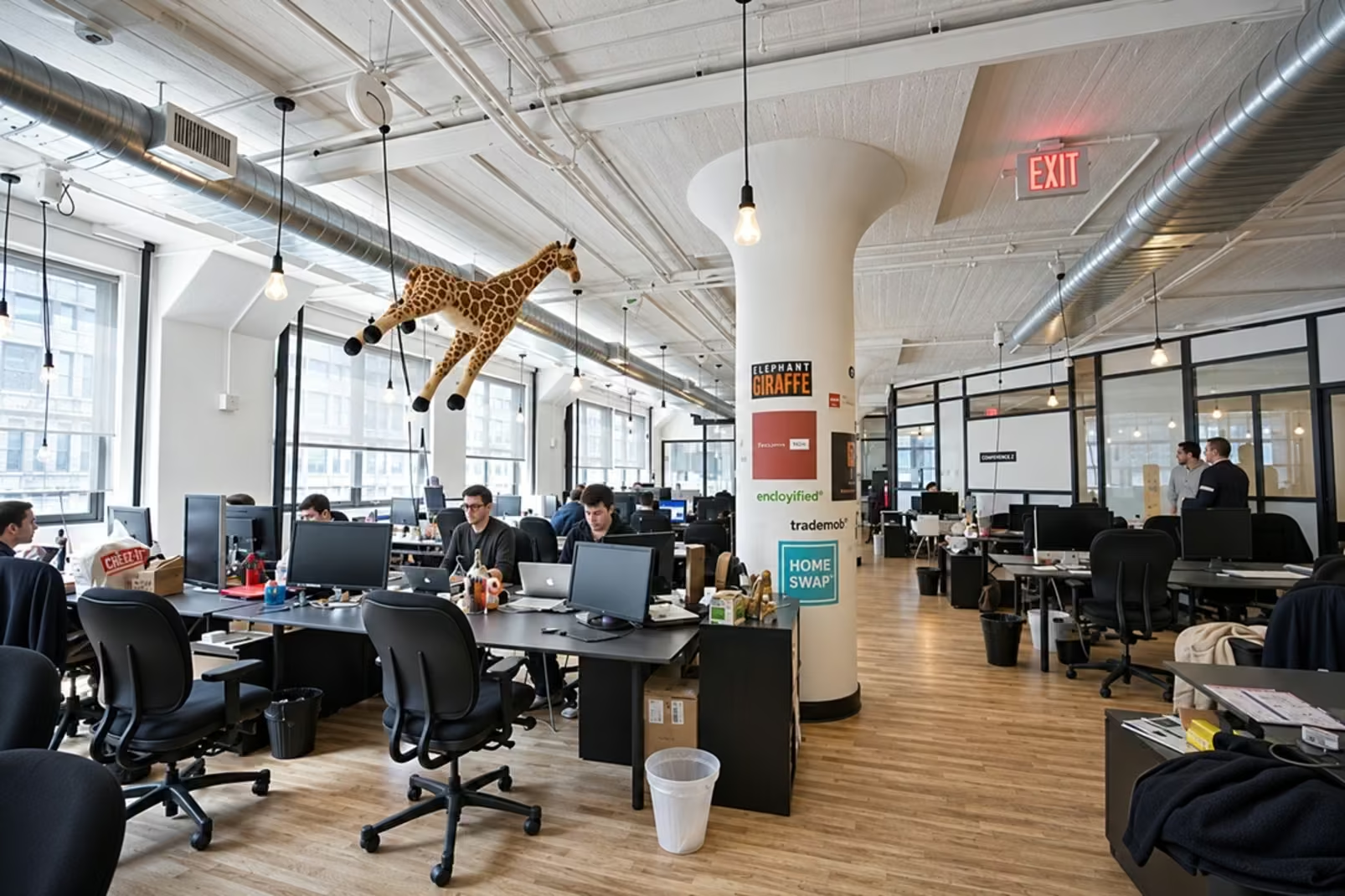 An example of a shared workspace in New York in the early 2010s.
2011: California operator NextSpace became one of the first coworking businesses to be backed by outside investors, and Liz Elam’s Global Coworking Unconference Conference (GCUC) began to take shape as a key event for the industry.
2012: Japan held its first coworking conference in Tokyo in June as the concept gained traction across Asia. Globally, the total number of coworking spaces had now passed 2000.
2013 & 2014: More operators began running multiple sites. By 2014, around 5800 spaces served about 295,000 members, almost double the figure a year earlier.
2015: Regus bought Spaces, a Dutch brand built around shared working and community, as long-standing serviced office providers began competing for coworking members.
2016: HSBC moved around 300 employees into a WeWork space in Hong Kong, while firms such as KPMG explored shared workspace for their teams. Around this time, we began hearing from larger firms seeking access to a coworking space alongside a private office.
2017: Deskmag’s annual survey estimated that more than one million people were now using coworking spaces, establishing coworking as a recognised office solution, rather than an unfamiliar alternative.
2018: WeWork opened its 50th location in Manhattan and became the borough’s largest private office tenant. Its rapid expansion relied on long-term property commitments, which would soon become a financial risk. WeWork also became London’s largest private office tenant earlier that year, while Impact Hub grew to around 100 locations across 50 countries.
Coworking Challenges: 2019 to 2024
The next six years tested the industry as WeWork’s troubles and the pandemic changed how businesses thought about office space.
2019: WeWork’s attempt to list on the stock market put its finances and governance under intense scrutiny. Co-founder Adam Neumann stepped down as chief executive, and the listing was withdrawn days later. This exposed a key risk in its business model, which relied on taking long leases from landlords while selling the space on a monthly basis to members.
2020: When COVID-19 lockdowns started, coworking spaces closed temporarily or ran under tight restrictions, and operators faced falling occupancy alongside new health and safety costs.

2021 & 2022: As restrictions eased and offices reopened, many teams did not return to five days a week in the office. Some companies cut back on traditional office space and found they needed fewer permanent desks, so they turned to coworking to avoid paying for empty space. Operators responded to this by offering part-time memberships and day passes.
2023 & 2024: In November 2023, WeWork filed for Chapter 11 bankruptcy protection in the US, caused by losses and leases signed before the pandemic. Its financial difficulties did not signal the end of coworking; instead, they raised questions about how flexible space should be funded and run.
WeWork emerged from bankruptcy in June 2024 after eliminating around $4 billion (around £3.1 billion) of debt and significantly reducing its portfolio. Across the sector, more landlords began running flexible workspace themselves or partnering with operators through management agreements. We often see this in our own listings, with more coworking and flexible spaces now run directly by the building owners.
Coworking Matures: 2025 to 2026
2025: By 2025, coworking was a core part of the wider flexible office market, growing more steadily than in the 2010s. The number of coworking spaces across the world had risen to around 42,000. Hybrid work had also taken hold, with 28% of working adults in Great Britain splitting their week between home and the office in early 2025.
Coworking still served freelancers and small businesses, and it was now also a common choice for hybrid companies, alongside private serviced and managed offices.

2026: CoworkingCafe recorded 4,876 coworking locations across the UK and Ireland, including 1,276 in London. Despite the growth in supply, our historical pricing tool shows that coworking prices have only risen moderately. Across the coworking spaces in London that we list, the average desk rate increased from around £261 per month in 2015 to £284 in 2026, an increase of about 9%.
Clients we work with often tell us they want the freedom to move between hot desks and private offices as their team changes. Many of the buildings we market now combine coworking floors and serviced offices under one roof. We cover these shifts in our article that explores the different ways we've seen coworking change over the last 10 years.
What's Next for Coworking?
The future of coworking depends on how well spaces meet the needs of individuals, small teams and larger businesses while staying commercially sustainable. The movement has developed from small communities of independent workers into an established part of the global office market.
Technology, changing workplace habits, and demand for shorter commitments drove this growth, while the pandemic and restructuring of major operators put the industry under strain.
According to The Business Research Company, the global coworking market is forecast to reach $53 billion (around £40 billion) by 2030, up from $26 billion (around £20 billion) in 2025. That’s growth of around 15% a year, enough for the market to double in five years.
More than 20 years after Brad Neuberg opened his first coworking space, the original idea still holds. Coworking gives individuals a place to work alongside others.
If you’re searching for a coworking space or even a private office to rent, we can help you find the right option today.
Tim Berners-Lee’s Proposal, CERN
c-base, official website
What Is a Hackerspace? Key Industry Terms Explained, Allwork.Space (2019)
Coworking Spaces in Vienna, Deskmag (2012)
The Start of Coworking (From the Guy that Started It), Brad Neuberg
Coworking’s Sudden Growth Gives Traditional Offices Some Competition, Associations Now (2014)
Coworking Visa Overview, Coworking.com
Coworking Spaces Worldwide, Statista
Coworking Statistics: All Results of the Global Coworking Survey, Deskmag
HSBC Moves 300 Staff to WeWork Hot-Desking Site in Causeway Bay, South China Morning Post (2016)
WeWork Is Now Manhattan’s Largest Office Tenant, The Real Deal (2018)
Weil Guides SoftBank in Successful Restructuring of $4 Billion in WeWork Debt, Weil
WeWork Emerges From Chapter 11, Davis Polk
Coworking Statistics and Key Trends Shaping the 2026 Flexible Workspace Industry, Allwork.Space (2025)
Who Has Access to Hybrid Working in Great Britain?, Office for National Statistics (2025)
U.K. and Ireland Coworking Market Surpasses 4,800 Locations, Allwork.Space (2026)
Coworking Space Global Market Report 2026, The Business Research Company (2026)